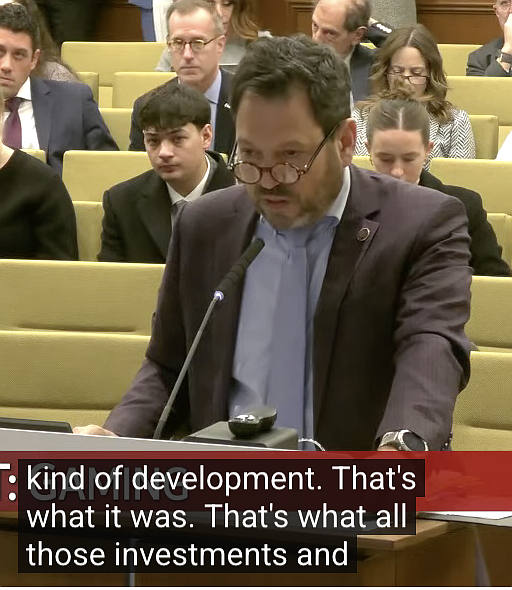
Sen. Scott Surovell, chief patron of SB 756, says there are multiple possible sites for a casino in Tysons.
State lawmakers on Jan. 23 moved to advance a Tysons-area casino bill despite the Fairfax County Board of Supervisors’ recent vote against the project. The Senate General Laws Gaming Subcommittee’s 5-3 vote followed the recommendation to report Senate Bill SB 756 and refer it to the Finance and Appropriations Committee. This sets the stage for a high-stakes legislative battle this session.
Voting “aye” were senators Lashrecse Aird, D-Chesterfield; Todd Pillion, R-Washington; Jennifer Carroll Foy, D-Prince William; Bryce Reeves, R-Orange; and Jeremy McPike, D-Prince William. Voting “no,” Adam Ebbin, D-Alexandria; Christopher Head, R-Botetourt; and Danica Roem, D-Manassas.
SB 756 would add Fairfax County to the list of localities eligible to host a casino in the commonwealth. Chaired by McPike, the subcommittee’s vote begins the process toward a possible referendum even though the Fairfax County Board of Supervisors voted 5-4 to oppose the bill on Dec. 9, 2025.
The 5-4 vote by the Fairfax County Board of Supervisors supported a proposal from Hunter Mill District Supervisor Walter Alcorn to oppose casino legislation until a majority of supervisors requests it and several other criteria.
“Fairfax County’s legislative position on a casino is clear,” Alcorn said in an email to The Connection on Jan. 21. “We oppose any bill to bring a casino to Tysons without the Board of Supervisors requesting it, as explicitly stated in our adopted state legislative program. Tysons is the economic engine of Fairfax County, and a casino would undermine the ambitious and award-winning Tysons Comprehensive Plan.”
Sen. Scott Surovell (D-Fairfax) framed SB 756 as a way to address Fairfax County’s projected $300 million budget gap and stop hundreds of millions in gambling dollars from flowing to Maryland’s MGM National Harbor. “The county is looking at a $300 million deficit, while Loudoun County, right next door, with 40% of the population, has a $300 or $250 million surplus,” Surovell said. “This would not only generate about $200 million a year for the county … it would also generate about $2 billion per decade for the state for school construction.”
Because of specific geographical requirements in the text — within one-quarter mile of an existing Silver Line Metro station, part of a development of at least 1.5 million square feet, outside the Capital Beltway and within 2 miles of a major regional mall — the measure is widely understood to be a “Tysons casino” bill. However, Surovell made clear SB 756 targets “multiple” Tysons sites. “There’s two sites right now that are currently, I think, assembled, that could be possible for this,” he said.
Final passage of the current bill does not automatically approve the construction of a casino. What passage of SB 756 would do is grant Fairfax County the authority to hold a local referendum. Voters in the county would have the final say. The measure, identical to the 2025 version, would still require Fairfax County Board of Supervisors approval and a local referendum, according to Surovell.
Pro-casino Testimony
Pro-casino advocates testified that it would create thousands of union jobs. “For workers in Northern Virginia who are struggling to get by in low-wage jobs, this is an opportunity to create thousands of jobs that can lift people up,” said Mike Hashi of UNITE HERE. Virginia Diamond, president of the Northern Virginia Labor Federation, added that “working-class residents of Fairfax County deserve the right to have a vote.”
Opposition Testimony
Opponents countered that Fairfax never asked for a casino and that placing one in Tysons would upend years of local planning. “Fairfax County stands in opposition, largely due to … the usurping of the local land use authority,” said Jennifer Van Dyck, representing Fairfax County.
Vienna Mayor Linda Colbert added, “Fairfax County did not ask permission to build a casino. We do not want it.”
Calls for Further Study and Alternatives
Jennifer Falcone, of the Citizens for Great Falls and the No Fairfax Casino Coalition, said SB 756 should not move forward without an independent JLARC study. Reena Hicks, of Freedom, Virginia, insisted lawmakers should find fairer ways to raise revenue, noting that research shows over 70% of people in Fairfax would prefer to ask the ultra-wealthy and corporations to pay their fair share.