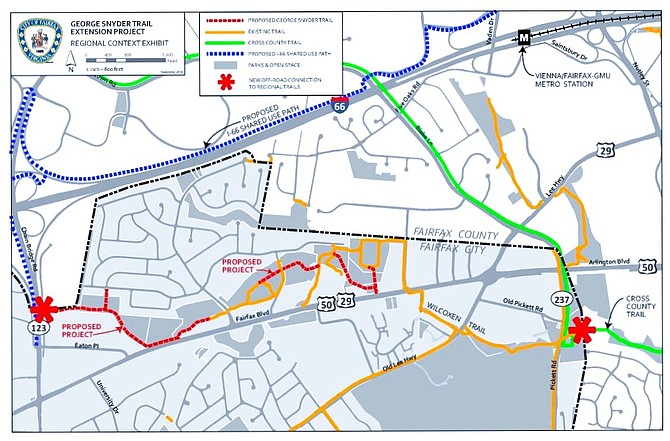
The George Snyder Trail alignment is outlined in red.
Taking a machete to previously approved projects seems to be the goal of some of the newest Fairfax City Councilmembers. And they don’t mind at all that the City will lose credibility by reneging on its promise to build them and must now repay the millions of dollars it’s already received from outside sources to carry them out.
The latest casualty is the long-anticipated George Snyder Trail, which has been on Fairfax’s Comprehensive Plan since 2012. This Council approved it last June but then canceled it last week. And just as this project split the community into factions for and against it, the trail split the Councilmembers as well.
At the public hearing last Tuesday, Jan. 13, City residents spent nearly 2-1/2 hours speaking on both sides of the issue. Afterward, Councilmember Anthony Amos tried to be a peacemaker while advocating for the trail to continue. Noting that two things can be true at the same time, he said, “You can like this trail and still acknowledge its environmental concerns.” However, he was also uneasy about “canceling a project after being awarded the funds.”
“There’s legitimacy to everything people said today, but it’s time to move on,” said Amos. “We keep going at each other’s throats, and I think it’s unhealthy for our community to keep prolonging it – so let’s get it done.”
Councilmember Stacy Hall, however, disagreed. She sided with the residents who argued that the project’s scope had grown way too big since its inception and would cause hundreds of trees to be cut down. “I want trails, but like the [mainly gravel] one in Daniels Run Park – not one with huge walls,” she said. “[The Snyder Trail] began as a stone-dust trail, and I’d like it to go back to that. I won’t support this trail.”
The Snyder Trail would have spanned almost two miles and included asphalt and concrete boardwalks, retaining walls, and bicycle/pedestrian bridges. ADA-compliant, this shared-use path would have joined Chain Bridge Road to the Wilcoxon Trail at Draper Drive, south of Fairfax Boulevard. It would have also connected to the existing Cross County Trail.
The City has already been awarded $20.6 million to build it, with more than $13.6 million of that amount coming from VDOT’s concessionaire funding because it would have connected VDOT’s shared-use path along Route 123 as part of the I-66 Outside the Beltway improvements, enabling Snyder Trail users to also reach Washington, D.C. and Haymarket along the I-66 corridor.
So far, the City has spent $3.7 million on design, environmental review and right-of-way acquisition. However, it recently received construction bids exceeding the $16 million left in the budget to complete the project. That meant Fairfax would need $4.6 million more from VDOT. But it came through. The City requested the extra money from the Northern Virginia Transportation Authority (NVTA) – which makes funding recommendations to the Commonwealth Transportation Board (CTB) – and on Jan. 6, the CTB approved it.
Then, came last week’s public hearing on whether to approve the appropriation of the additional $4.6 million for the Snyder Trail. (See sidebar). Afterward, the Councilmembers deadlocked on a vote to do so. Fairfax Mayor Catherine Read has long championed this project. But since the City’s charter prohibits the mayor from voting on monetary appropriations, she couldn’t break the tie. As a result, the motion to accept the appropriation failed and the trail project was canceled.
That means Fairfax can’t keep the $20.6 million, nor shift it to a different project – and it must repay the $3.7 million from its General Fund. Furthermore, coupled with the $4.6 million it also asked for and was awarded, the City is leaving $25.2 million on the table – with nothing to show for it.
This number is in addition to the $9.5 million it received for the George Snyder Trail Extension, which will not be built either, as well as the $5.1 million for the already approved Country Club Commons Connector Trail this Council killed last April – for a total loss to the City of $39.8 million.
Following the public hearing, Councilmember Stacey Hardy-Chandler made a motion to approve accepting the extra money from the NVTA, and Amos seconded it. Agreeing with them, Councilmember Billy Bates said, “This project would provide a shared-use path at one of the busiest corridors in the City and a direct connection to the Gerry Connolly Cross Country Trail via the Wilcoxon Trail and the George Snyder Trail Extension – which has been funded.”
Bates also commented on the vitriol – sometimes aimed at City staff – engendered by this controversial project. Said Bates: “I’m so disappointed by the misleading rhetoric surrounding this project and the baseless attacks on our staff.”
Councilmember Rachel McQuillen stood firmly with Hall in opposition to the trail. “I support trails, connectivity and accessibility,” she said. “But this trail has been redesigned over the years to decrease its environmental impact, and that made its cost rise substantially. City staff deserves credit for obtaining outside funding for it. But ADA requirements will result in the need for about $25,000 in annual maintenance. I can’t support it.”
Hardy-Chandler said one of the “most poignant” things she heard that night was “from people who are still committed to this trail, after decades. This trail is about promises, reliability, credibility, partnerships and investing in the [City’s] infrastructure for the future. And it signals something larger than ourselves and what it means in terms of our future and governance decisions. The appropriation is the right thing to do.”
But Councilmember Tom Peterson was staunchly against it. “An appropriations vote ended the Vietnam War, and I think it’s fitting an appropriations vote will end this one,” he said. “I won’t be supporting it. It’s not a great idea to build a project simply because you’ll be penalized if you don’t.”
Noting that she was barred from voting on the appropriation, Read said, “I sit on the NVTA Board [which] recommended to the CTB that we get this [additional] money.” She also stressed it would be incorrect for the City to not expect any financial consequences for backing out of a major project.
After all, since Fairfax actively fought for the money to build the Snyder Trail, its extension and the Country Club trail – then canceled these projects after receiving nearly $40 million that otherwise would have gone to other jurisdictions – the funding entities are more likely to think twice before granting any City monetary requests in the future.
“I want to be clear that we operated in good faith with NVTA,” said Read. “NVTA went to bat for us. Understand that we have reneged on a commitment that we made, and there are always repercussions for the decisions we make.”
Council then voted on Hardy-Chandler’s motion to approve the appropriation, with Peterson, Hall and McQuillen voting no and Amos, Bates and Hardy-Chandler voting yes. Since there was a 3-3 tie, the motion failed. That action resulted in a resolution by Peterson to instead cancel the Snyder Trail, and that vote passed, 4-2, with Hardy-Chandler and Amos voting no.