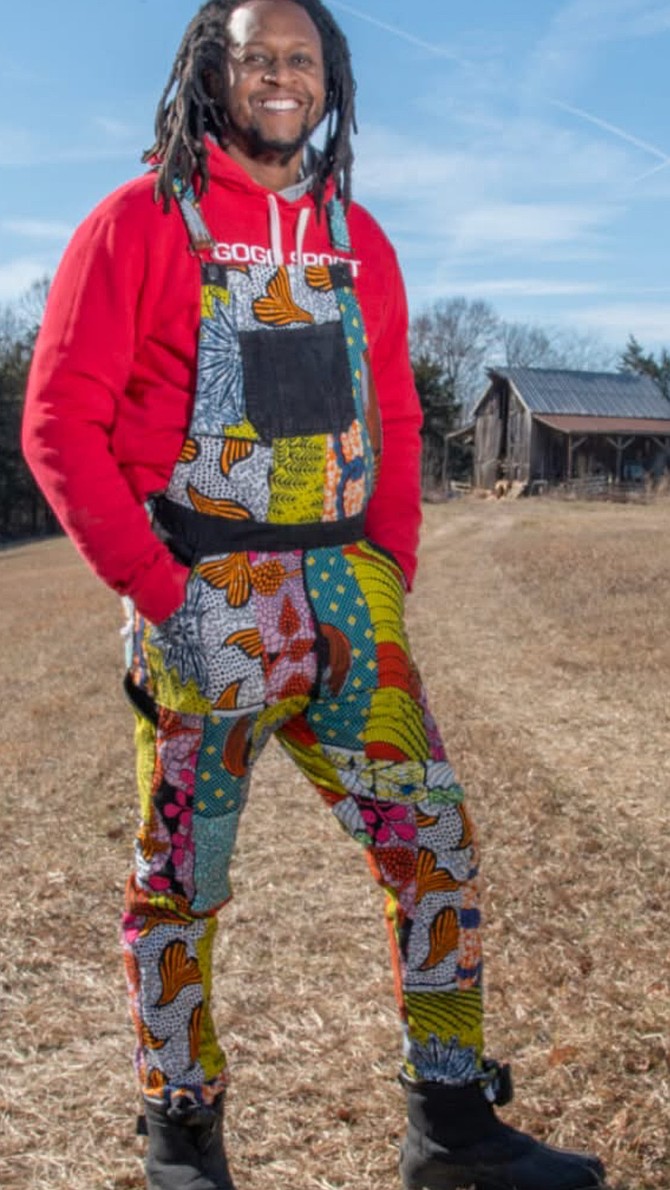
Michael Carter Jr., 11th generation farmer.
Interview with Michael Carter, Jr., Carter Farms, Orange County on proposed Valley Link project to carry electricity to NOVA, driven by the explosion of AI-ready data centers.
Carter Farms is a historic century farm in the Piedmont region, Unionville, in Orange County, Virginia. The farm specializes in growing ethnic, African tropical vegetables organically. Michael Carter Jr., an 11th-generation American farmer, is the fifth generation to work at Carter Farms, where he leads workshops on growing and marketing ethnic vegetables.
Carter Farms is under the wire of the Valley Link Project, a joint venture between Dominion Energy, FirstEnergy, and Transource. The proposed project, a "power interstate," aims to move electricity from the Ohio River Valley to high-demand areas in Northern Virginia via the Joshua Falls – Yeat Project. The proposed 115-mile, 765-kilovolt transmission line featuring lattice steel towers between 135 and 160 feet tall, would run from Campbell County to a new substation in Culpeper County. According to the project’s FAQ page, Valley Link will purchase easement rights from each affected property owner based on third-party appraisals and negotiations.
This infrastructure is a direct response to the massive energy demands driven by the explosion of AI-ready data centers in “Data Center Alley,” located in Loudoun, Prince William, and Fairfax counties in Northern Virginia, the global leader in the number of data centers and other factors. Dominion Energy projects that Virginia’s electricity demand will nearly double in the next 15 years, almost entirely due to these centers, according to Dominion Energy Virginia: Data Centers & Energy Demand (Piedmont Environmental Council Analysis).
As of April 2026, the project is in the public comment and route refinement phase. It has met significant resistance from residents and elected officials in rural counties such as Goochland, Louisa, and Orange, who say their landscapes are being sacrificed to power data centers in other regions and they get no benefit from it.
On March 13, Carter, who is opposed to the project, participated in a nearly 30-minute, one-on-one interview with The Connection Newspapers, whose readership extends across Fairfax County, including parts of Data Center Alley, so readers and elected officials there and elsewhere can understand what is happening through Carter’s eyes.
Legacy, Family History, and Connection to the Land
Carter presents himself as the current family member carrying the responsibility of keeping the farm and its history alive. He explains: "If I leave, the farm is done and the legacy is … done." Carter frames his role as steward and connector to the land. "I feel that in this season it is my responsibility to be that connector … I'm carrying a baton right now for the family." Carter links his decision to remain on the farm directly to whether the transmission lines are built nearby. If they come, he said, "My son's not being encouraged to stay, and they would know why I left. So I would have left because of my health … and just fed up with the fact that you could do this in a rural community."
Health Concerns
Carter emphasizes that he is "a very health-conscious person" and that the proposed routes would place large transmission towers very close to Carter Farms. "One [route would run my] neighbor's property, in their pond, one right behind our property... we’d [be] sandwiched between two of those giant, massive lattice steel towers," he said. Carter added that because of past experiences with friends’ and family members’ childhood cancers, "I would ideally move out of the state or the country if that were to happen."
Because he does not trust industry assurances about cancer risks, Carter said, "I would not want to put my grandchildren, my unborn grandchildren, in that particular environment where they could be exposed to a higher percentage [of the power frequency fields of a 765 KV line] than a normal person. … From everyone who's done studies with industry, nothing they produce causes cancer. So cigarettes don't cause cancer. Asbestos didn't cause cancer. Agent Orange didn't cause cancer … so nothing causes cancer when everybody gets it,” Carter said.
[Valley Link states in its Frequently Asked Questions, What is EMF? “Scientists across the globe have studied the potential health impacts of EMF since the 1970s and found no cause-and-effect link between EMF exposure from power lines and negative health impacts. The Valley Link team is studying the EMF of the conceptually designed line. … Engineers will design lines to minimize EMF.”]
History of Racial and Environmental Discrimination in Land Use
Carter places the current transmission line proposal in a longer history of "racial, environmental discrimination." He specifically mentions Lake Anna and Black families whose homes and land were lost, referring to the creation of Lake Anna and the North Anna Power Station in the late 1960s and early 1970s. Authorities "removed several Black families,” Carter said. “They did take houses … they didn't take them in a sense of living in; they took them in terms of flooding them and putting them under water."
When Virginia Electric and Power Company (VEPCO, now Dominion Energy) moved to build the nuclear plant, they needed a massive cooling system. This required damming the North Anna River and flooding roughly 18,000 acres of land across Louisa, Orange, and Spotsylvania counties. Louisa County Historical Society and regional reports verify at least 14 families, with some records indicating nine Black families specifically were displaced.
Carter noted that the Lake Anna loss has not been publicly recognized: "At least nine families … African American families that were displaced, which never gets talked about and they don't have any type of monuments or any type of recognition for that. … Those families and that land is lost. Their history is lost, their heritage is lost," Carter said.
Colonial Pipeline and ‘Pennies’ for the Easement
Carter explains that this is not the first time his family’s land may be carved for infrastructure. “Through our farm now runs the Colonial Pipeline, which is gas; it runs from Pennsylvania to Texas. We got pennies for it," he said. Carter recalled the payment as insignificant for the three or four acres taken: "We may have gotten $1,500 an acre." He added, "That one-time payment… is not the same as we sold it in 2025 or kept it, you know, for the accruing of land value." If land is taken for Valley Link, Carter said the payment should include some kind of stake in the company. "To pay a very high premium price, in addition to shares in the company … so that as the company grows, we grow financially."
Alternative Routing: Existing Highway / Route 29 Corridor
When asked whether routing along existing highways would allow him to stay on the farm, Carter pointed to Route 29. "It's going from Campbell County, which is Lynchburg, straight to Culpeper." Carter notes there is already a right of way: “The space is there … there's not a lot of houses. … The houses are spaced out well. There's a lot of trees, woodlands, mountains, etc. It's not a heavily populated route … not in comparison to what you're dealing with here," he said.
Carter contrasts this with the current proposal: "You're impacting a lot of individuals across nine counties. You're not impacting as much going down 29."
Tyranny, Institutions, and What Is ‘Sacred’ in Virginia
Carter discusses the Virginia motto, Sic Semper Tyrannis, and the idea of resisting tyranny. “We had tyrannical institutions in the form of the enslavement of Africans. But there was this idea that land was what we sought. We stole it from the indigenous people here … and now we're having it stolen again for the sake of the devaluing of our communities." Carter sees data centers and transmission lines as part of a pattern where large projects override local communities. “[Data centers are] pretty much an institution of humanity as we know it." He added, "I'm always curious about Virginia, what is sacred anymore. I don't see what's sacred anymore, besides data centers."
Data Centers, Future Generations, and Message to State Regulators
Carter makes it clear that he sees the primary beneficiary as data centers, not residents. "At the end of the day, that's what all of this is for, for electricity, for data centers, which they've admitted is not for human, not for citizen consumption." When asked what he would say to state regulators and county supervisors in Fairfax, Loudoun, and Prince William, Carter said: "Stop. For the sake of their grandchildren, stop building data centers. Stop building data centers for the sake of their grandchildren. Forget about you, forget about your children, your grandchildren, your great-grandchildren. Because, unfortunately, you can't eat a data center. You aren't going to be able to work in a data center. … At the end of the day, it's destroying much more than it's building up."
Carter adds that these projects are destroying histories "of families and the fabric of this commonwealth, of this land, for the sake of data centers." He concluded, "I'm sure that's not what the indigenous Americans had in mind. That's not what the Founding Fathers had in mind. That's not what the enslaved Africans had in mind, for this land to be bought by machines and those … who desire much more … to be wealthy than … keep and maintain [as] the stewards of the land."