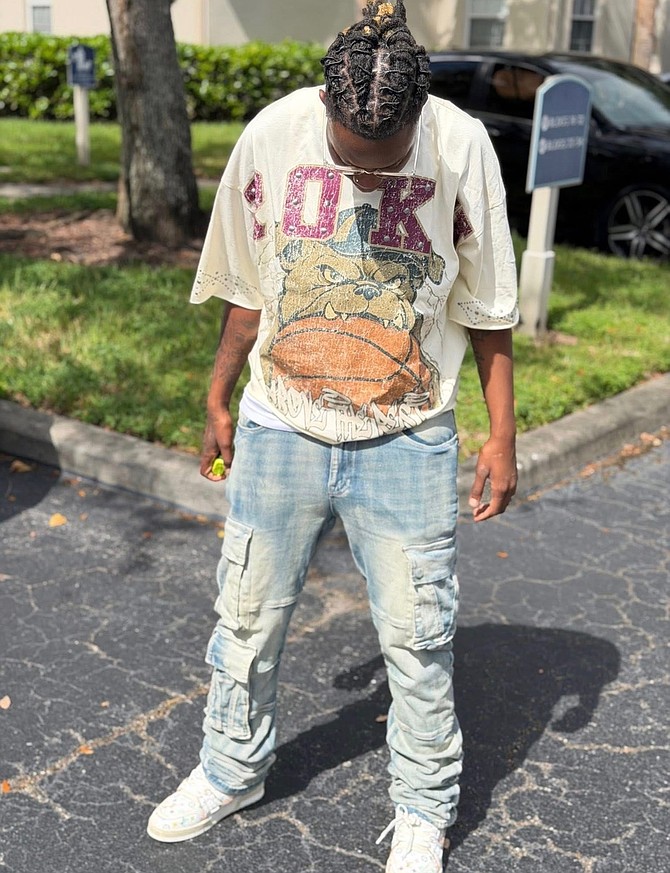
Ray, 28, moves through Falls Church with the practiced awareness that comes from living at the intersection of Blackness, womanhood, and trans identity.
Ray walks like she’s listening to the world talk back to her — chin up, shoulders loose, eyes scanning the block the way some folks scan a menu. Twenty‑eight years old, slim and sharp, she moves through Falls Church with a cadence that’s half‑confidence, half‑survival. “You learn to read a street before it reads you,” she says. “That’s just real.”
She used to be Renee. She says that name now feels a pair of shoes that she’s outgrown. They are still in the closet somewhere, but not something she slips into anymore. “Renee was who I had to be,” she says. “Ray is who I am.”
Ray doesn’t give her last name. Not to some coworkers of her coworkers and definitely not to strangers. “Privacy is armor,” she says. “And I need all the armor I can get.”
National data underscores her perspective. The Human Rights Campaign has documented hundreds of killings of transgender and gender‑nonconforming people since 2013 and Black transgender women make up the majority of victims. Federal agencies echo the same pattern: the U.S. Department of Justice reports that transgender people face far higher rates of violent victimization than cisgender people; the CDC finds that Black LGBTQ+ women experience disproportionate levels of sexual and intimate‑partner violence; and FBI hate‑crime statistics show a steady rise in anti‑transgender assaults, with Black trans women disproportionately targeted. Taken together, the federal data and Human Rights Campaign’s tracking confirm what advocates have long said: Black transgender women face some of the highest levels of violence of any group in the country.
Ray doesn’t need the numbers to know the truth. She remembers the night she was attacked. It was late, too late to be walking, but the bus was behind schedule and she wanted to get home. She was in the middle of a crosswalk when a car slowed, windows down, bass rattling the frame. A man leaned out, eyes locked on her like she was a rhetorical question and he didn’t like the answer.
“Yo,” he called. “You a girl or what?”
Ray kept walking. She thought silence was the safest language, but in this case it was not.
The car door swung open. He came at her fast, grabbing her arm hard enough to leave a bruise in the shape of his fingers. She twisted, stumbled, scraped her palms on the pavement. Someone shouted. The man hesitated just long enough for Ray to break free and run.
She didn’t stop until she reached a gas station. She stood there shaking, breath ragged, hands bleeding. “I wasn’t scared of dying,” she says. “I was scared of becoming a headline.”
She didn’t call the police. “What was I gonna say?” she asks. “That a man grabbed me because he didn’t like the way I exist?”
Instead, she called her partner, Tasha, who showed up in ten minutes flat, still in her scrubs, eyes wide with worry. Tasha wrapped her up right there under the fluorescent lights, whispering, “You’re okay, baby. I got you.”
Ray says it was in that moment, in Tasha’s arms, bright lights overhead, that she decided to choose herself over fear.
Now, during Pride Month, Ray feels emboldened, not because the world is safer — it isn’t — but because she’s decided she deserves to be true to herself. She and Tasha hold hands in public. They laugh loud. They live louder.
“I carry pepper spray, you have to be smart about it, but we’re not going to be a statistic,” Ray says. “I’m a whole person. And I’m still here.”
She pauses, then adds, “And being here? That’s my protest.”