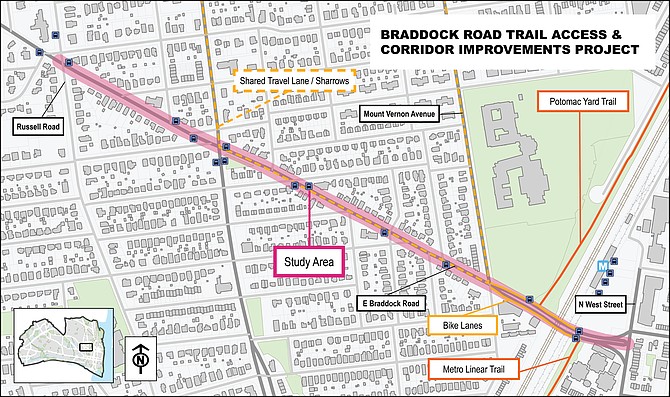
The controversial Braddock Road Trail Access and Corridor Improvements project is intended to enhance safety and accessibility for all roadway users along Braddock Road between Russell Road and North West Street.
After more than 10 hours of public testimony and debate, the Alexandria City Council voted 4–3 to move forward with a controversial plan that will remove most on-street parking along a stretch of Braddock Road to make way for new bicycle lanes and safety improvements.
The May 16 vote upheld a February decision by the city’s Traffic and Parking Board, rejecting an appeal from residents and local institutions who sought to preserve parking along the corridor.
The project will significantly reshape a roughly 0.8-mile section of Braddock Road between North West Street and Russell Road. Under the approved plan, most on-street parking along this stretch will be eliminated, with limited exceptions, in order to install protected bike lanes and reconfigure traffic flow.
The decision came at the end of one of the most closely watched and emotionally charged hearings in recent city history. More than 100 residents and stakeholders spoke during the marathon session, reflecting deep divisions within the community.
Mayor Alyia Gaskins, Vice Mayor Sarah Bagley, and Council Members Canek Aguirre and Sandy Marks voted in favor of the redesign, while Council Members John Chapman, Jacinta Greene, and Abdel Elnoubi opposed it.
The council’s decision means the project will move into its next phase of detailed design, with construction expected in the coming years.
Key elements of the Braddock Road Corridor Improvements Project include: Installation of protected bicycle lanes along much of the corridor; Reduction of travel lanes in some sections to calm traffic; New pedestrian safety features, including shorter crossings and improved crosswalks; and a commercial loading zone to support nearby businesses.
City officials say the changes are intended to improve safety for all users, including drivers, cyclists and pedestrians.
In addition, the council approved several modifications to address community concerns. These include preserving a small number of parking spaces near Good Shepherd Lutheran Church and exploring additional crosswalks and accessibility improvements.
The removal of parking emerged as the central point of debate throughout the process.
Opponents argued that eliminating parking would create hardship for residents, particularly those without driveways, and for churches and local organizations that rely on street parking for congregants and visitors.
Some residents also expressed concerns about traffic congestion and access for deliveries and services if parking spaces are removed.
Supporters, however, emphasized the need for safer streets, particularly for cyclists and pedestrians. Advocates pointed to prior city data and feedback suggesting many residents view the corridor as unsafe for biking and walking.
Transportation officials have said the redesign will help connect existing trail networks and create a safer route to the Braddock Road Metro station and nearby schools.
With the vote finalized, city staff will continue refining the project design before construction begins. Officials have indicated implementation could take place later in the decade.
While the decision settles the immediate question of parking removal, it leaves lingering tensions among residents over how best to balance transportation needs, safety and neighborhood impacts.
The Braddock Road project stands as one of the most contested transportation changes in Alexandria in recent years, reshaping not only a key corridor but also the broader conversation about mobility and community priorities in the city.