Many people like to watch birds, hang up bird feeders and download birding apps, but unlike birds, fish are “out of sight and out of mind,” said Mike Pinder in an online presentation titled “Freshwater Fishes, Exploring Virginia’s Hidden Treasures” to the Friends of Dyke Marsh and others.
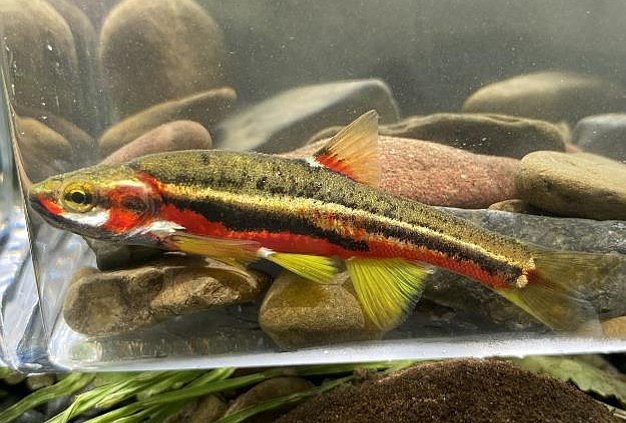
“A bright red male cardinal pops right out,” he said, and red-bellied woodpeckers and green herons have distinctive colors. Birds have colorful fish counterparts, he argued, fish like the candy darter, red-bellied dace and greenfin darter.
Pinder, an aquatic biologist with the Virginia Department of Wildlife Resources, wrote in a Virginia Wildlife magazine article that people don’t have to travel to tropical coral reefs to see colorful fish. “Our own rivers and streams contain brilliantly colorful darters in addition to a multitude of other fascinating aquatic creatures just waiting to be discovered.”
He proved his point with photographs of a bright blue, male spotfin chub that he says likes fast water. “It looks like it’s been plugged into an electrical outlet,” he quipped. He also shared a picture of a three-inch long, red-belly dace with an orangey-red stripe on its belly and gold-colored fins.
The candy darter, found exclusively in southwest Virginia’s New River drainage in fast-moving water, is “one of most beautiful freshwater fishes in North America,” he touted. This fish can be up to four inches long and has alternating vertical greenish and red-orange bars on its sides. The female is dull, he said, perhaps because she is carrying eggs and tries to not stand out. The candy darter is on the state and federal endangered species lists.
225 in the State
Virginia’s rivers and streams are home to 225 freshwater fish species in 26 families. The Potomac River watershed, one of 10 in the state, has 64 native species and one not native, the northern snakehead.
Freshwater fish are the second largest vertebrate group in Virginia behind birds. Sport or game fish like bass and bluegills may be better known, but they are “a small component of Virginia’s fish,” he said.
Since fish are not easy to see, they do not get as much protection as many other animals, he said. In Virginia’s Wildlife Action Plan, 38 percent of the state’s freshwater fish have some level of need of conservation.
Three Virginia Habitats
Pinder reviewed three habitat types in the state, starting with the western mountains or Appalachian plateau where mountain streams flow fast with churning water. Virginia’s state fish, the brook trout, thrives in these waters.
In the Piedmont physiographic region streams are flatter, have lots of ripples, deep pools and a pea gravel substrate. This area is home to the stripeback darter, for example.
The coastal plain is very flat, and “at times you can’t tell which way the streams are moving,” he said. Beavers dam up moving water in this region and ponds accumulate leaves and logs, so the water is dark and low in oxygen. Many species adapt to these dark waters like the four-inch-long blue spotted sunfish.
Pinder zeroed in on minnows, the largest family of fish in North America with 320 species and found in lakes, ponds, reservoirs, rivers and streams. “Not all minnows are small,” he said. “Colorado has a six-foot-long minnow.”
What makes a minnow a minnow? “It has one dorsal fin and no teeth on its jawbone. Its teeth are way back in the throat. Some teeth are sharp and pointed for eating aquatic insects, but others are like molars for grinding vegetation,” he said. Minnows are a foundational species and are eaten by other wildlife, like ospreys and kingfishers.
Viewers were captivated by videos of mound builders, fish like chubs that during the breeding season carry rocks in their mouths and make rock piles for nests. The chub digs pits in the rock nests and then mate in the pits usually between April and July. “A chub can carry 10,000 stones to make a mound. One traveled an accumulated distance of 16 miles to collect enough rocks to build a nest. They use the current to carry rocks downstream, which is pretty smart,” he said.
The mounds attract other minnows, called “nest associates,” that only spawn on a chub’s mound so if we lose chubs, we will lose minnows, the foundation of the food chain, he said.
Pinder ended by stressing the importance of biodiversity and clean water. “If a stream has a lot of fish, snails, crayfish, salamanders and mussels, it’s a healthy community. All these animals depend on each other. This is the water we drink. We cannot live without clean water. Just having water is not enough.
“To protect these animals is protecting ourselves. The more we know, the more we love it and want to protect it and its habitat,” he said.
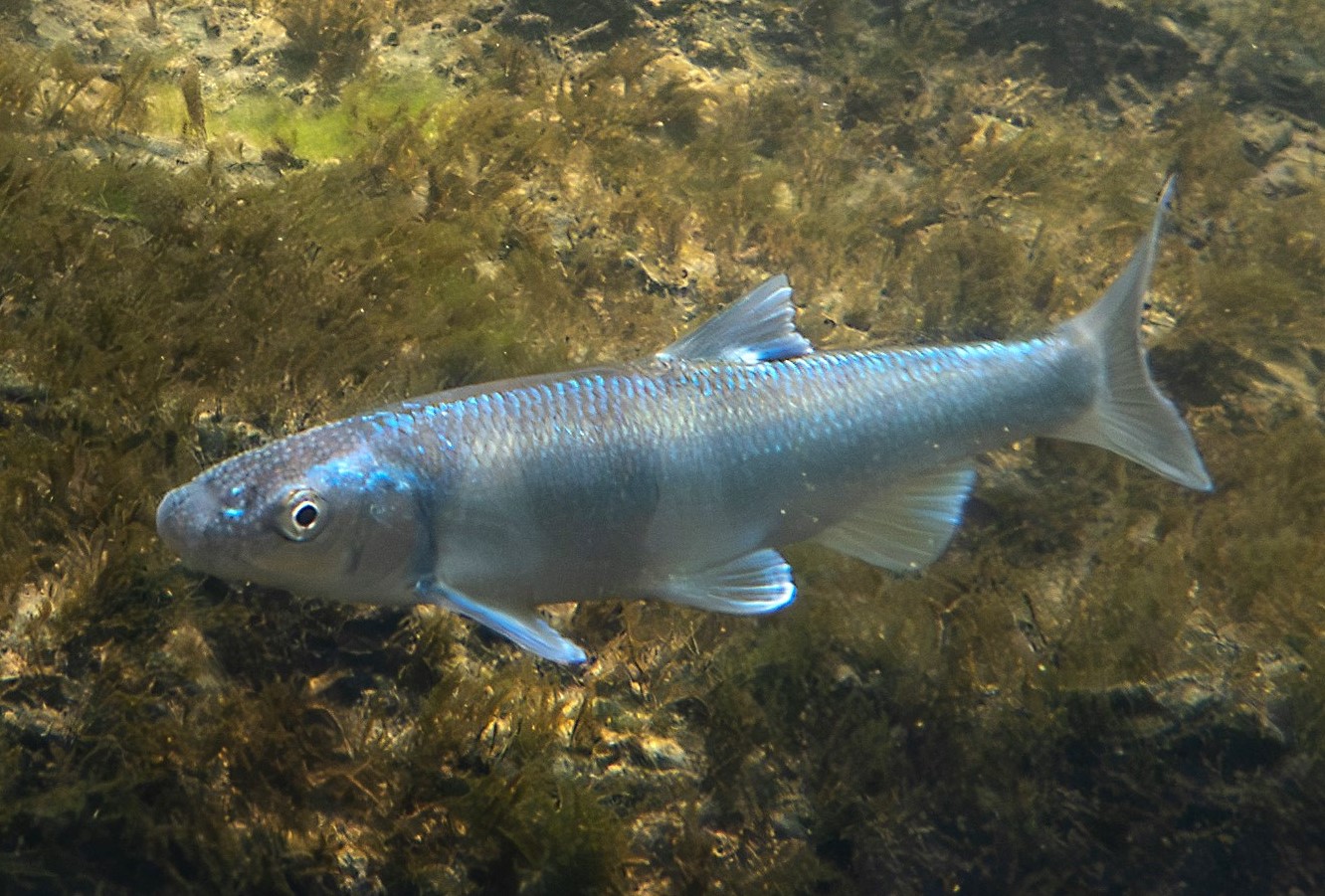 Spot Fin Chub