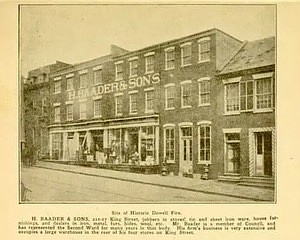
Fire was the great fear of 19th-century Alexandria. Wooden row houses stood shoulder to shoulder with warehouses full of flammable goods, and one spark could take a block. But the fire that broke out on the night of Nov. 16, 1855, was different. Someone set it deliberately, and before dawn it had cost seven lives.
The blaze began in the Dowell China shop in the 200 block of King Street. Volunteers from the city’s fire companies fought it through the night. Some worked the upper floors of the adjoining warehouse, and others worked its cellar.
At about four in the morning, the warehouse’s west gable wall gave way. Six men died beneath it. A seventh, John Roach, was pulled from the wreckage alive but died of his injuries at home. Six more were hurt. One of them was John Dogan, an African American laborer from Royal Street, who was lamed for life. It remains the deadliest night in the history of Alexandria’s fire service.
The dead were not professional firefighters. Alexandria would not have a paid fire department employee until 1866. They were neighbors and tradesmen who answered the bell. G. David Appich, a confectioner, was 21 and the youngest of the seven. William Evans was an English-born plumber. George O. Plain was a painter of 46. Robert I. Taylor was a pavior who helped lay the city’s streets. James W. Keene, a woodseller, belonged to the Friendship Fire Company. J. Carson Greene was the grandson of Dr. James Carson. Roach was the only Catholic among them.
Their graves are scattered across the city. Appich was buried in the Presbyterian Cemetery on Wilkes Street. Evans, Plain, Taylor and Keene went to the Methodist Protestant Cemetery nearby, though Keene’s exact grave has been lost. Roach rests in St. Mary’s Catholic Cemetery. For generations no one knew where Greene lay. In 2025, ground-penetrating radar confirmed his burial beside his family in Christ Church Episcopal Cemetery.
The fire companies did not let the loss fade. Friendship draped its engine house in mourning for six months, and the Star company kept its black bunting up for a full year. In 1856, the cornerstone was laid for a memorial obelisk at Ivy Hill Cemetery, carved with the names of the seven. In that year’s memorial procession, John Dogan carried the fire’s damaged hose nozzle, engraved with the names of the men who had died around him.
The obelisk still stands. The Friendship Fountain beside it was dedicated in 1970 and rededicated after September 11, 2001. Every Fire Prevention Week, Alexandria’s firefighters still gather there to remember.
No one was ever named as the arsonist. What remains is the memory of seven volunteers who went into a burning building on King Street because their town needed them. Readers can find every grave, along with the fire sites, at gravestonestories.com/fallen-firefighters-alexandria.
This story draws on the research of Catherine Weinraub, historian for the Ivy Hill Cemetery Historical Preservation Society and the Friendship Veterans Fire Engine Association, and author of Friendship Fire Company 250th Anniversary, 1774–2024.
David Heiby is an independent historian, founder of Gravestone Stories (gravestonestories.com), and Superintendent of the Presbyterian Cemetery & Columbarium. He is Treasurer of the Alexandria Historical Society and of the Virginia Trust for Historic Preservation, which owns the Lee-Fendall House Museum, and a member of the Alexandria Archaeological Commission.