It was a chilly 58-degree morning and the coffee cooled off, but the rain stopped and spirits were lifted by the inspiring message of Charles Ross II at the Oct. 17 Gum Springs community’s celebration of the skilled tradesmen who helped build a free nation and the pastors of the community. Held outside under tents at the Harvest Assembly Baptist Church, the event was part of Fairfax 250, the county’s and country’s semiquincentennial.
Ross, a direct descendant of Gum Springs’ founder West Ford, came from Norfolk and said, “As a carpenter and tradesman, West Ford helped shape both the physical and social landscape of Gum Springs and beyond. His craftsmanship was more than a profession. It was an expression of ingenuity, hard work, responsibility and commitment to others. He built more than structures. He built opportunity, dignity and hope for his family and for generations to come.”
Ross reminded the group that Ford was enslaved, learned to read and write, managed the Mount Vernon plantation and became free in 1805. In 1833, he founded Gum Springs, one of the oldest free Black communities in Virginia. “His vision and leadership shaped the early development of Gum Springs,” Ross said, “and left a lasting legacy of empowerment, education and community building.”
Ross encouraged all to mentor young people, to “teach a young person how to use a tool safely. Explain why accuracy matters. … Invite them to observe, practice, ask questions, make mistakes and grow. One hour of patient instruction may awaken a gift that changes a life, strengthens a family and transforms a community.”
Queenie Cox, the event’s organizer, called Ross’s remarks “really beautiful.”
Dorothy Johnson told him, “I was really moved by your words.”
Pastor Johnnie Abram said he was “excited about how God brings all the people together.”
As the group warmed up with fellowship, pastries and eggbites, Ross invoked Ford’s spirit, “a spirit that values hard work, integrity, resilience, learning and service. Gum Springs stands today as a testament to the power of that heritage and as a beacon of hope for generations yet to come.”
Ross grew up on Long Island, New York, and is a graphic designer and voice-over actor. During almost 16 years in the U.S. Navy, he trained and equipped servicemen and women in air crew survival all over the world and taught these skills at installations like Naval Air Station Patuxent River. Growing up, his family members never mentioned a link to Ford. When he submitted his DNA to Ancestry.com in 2019, his connection to West Ford, “just popped up,” to his elation, he said.
A Statue and Walkway
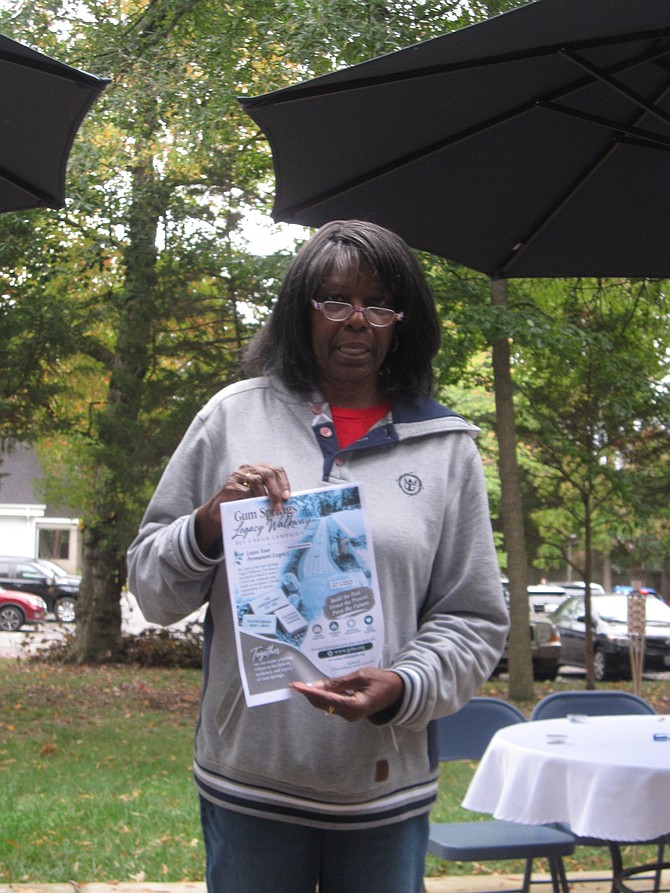
The Gum Springs Homeowners Association has two legacy projects underway, a statue of West Ford designed by Michael Alfano which will stand at the corner of Sherwood Hall Lane and Fordson Road; and a brick walkway between Dumas and Douglas Streets. To help by purchasing a brick, contact info@gsho.org.
Gum Springs is near U. S. 1 in the Mount Vernon District. According to the Fairfax County African American History Inventory, Ford purchased a 214-acre farm there after he was freed by Hannah Bushrod Washington, wife of George Washington’s brother, John Augustine Washington. “Located close to the Mount Vernon Estate, the community was a sanctuary for freedmen and runaways. Samuel Taylor, a runaway slave, established the first institution in Gum Springs, the Bethlehem Baptist Church. Assisted by Quakers, the first school was established at Bethlehem,” the inventory notes.
A 1966 film about the community, titled, “Gum Springs, a Certain Pride,” is on YouTube at youtu.be/3UVGYaYFESg.