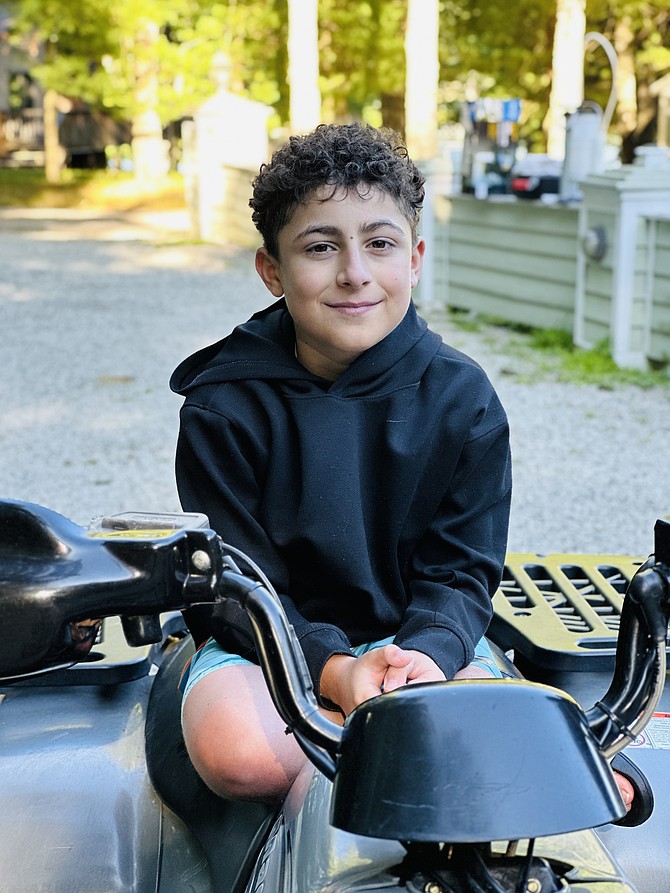
Darya Golesorkhi, 15, of Reston entered South Lakes High School this week as a sophomore. While she and her peers in Fairfax County Public Schools navigate new districtwide restrictions on generative artificial intelligence in classrooms, Darya is heading to Capitol Hill on Friday, Sept. 18, to champion AI’s life-saving potential.
A Personal Mission
Darya’s advocacy is deeply personal. Her 11-year-old brother, Kamran “Buddy” Golesorkhi, died on Aug. 19, 2025, after a long and fierce six-year battle with osteosarcoma. Treatments for osteosarcoma have not changed significantly in more than 40 years, according to Darya in an Aug. 29 interview with The Connection. When standard protocols fail, families have few options.
The Children’s Hospital of Philadelphia reports, “This bone cancer affects approximately 400 children younger than age 20 every year in the United States.”
Joining fellow bereaved siblings and young survivors from the nonprofit MIB (Make It Better) Agents, Darya plans to lobby lawmakers to pass the Accelerating Innovation (AI) for Kids with Cancer Act (H.R. 9632).
Harnessing AI for Oncology
Led by U.S. Rep. Michael McCaul, R-Texas, alongside co-sponsors U.S. Rep. Ami Bera, D-Calif., and U.S. Rep. Mike Kelly, R-Pa., the bipartisan legislation establishes a dedicated federal framework to accelerate pediatric cancer research through artificial intelligence.
The legislation aims to address key hurdles by using AI to break data silos, authorizing $100 million annually for the Childhood Cancer Data Initiative to merge fragmented hospital records, doctor notes, and genomic datasets into an accessible engine. The technology would also streamline trial design by analyzing complex biological data to identify hidden genetic subtypes and rapidly match rare-disease patients to targeted clinical trials. Additionally, predictive modeling would anticipate side effects and drug responses early, shaving years off Phase I through Phase III clinical trials.
Humanizing the Cause
Darya said her pitch to lawmakers will focus on the real-world impact behind the bill’s text. Asked what she plans to say, Darya grounds her reply in the need for families’ stories, not statistics, and frames the bill as something that could truly make a difference.
“I just really want them to hear different people's stories that are real, so they can see how this bill would affect people in the real world and how much of a difference it could truly make,” Darya said. “Extended research would just make things so much better.”
Before meeting with lawmakers, Darya will join other teens from MIB’s junior advisory board and next generation group for a training session led by Jennifer Flynn, outreach director for Kids v Cancer. Flynn and her organization previously worked on the Michaela Naylon Give Kids a Chance Act, another federal effort focused on childhood cancer.
Honoring Buddy's Legacy
Darya shared that the local community has helped raise nearly $200,000 ($193K) over the last couple of years #becauseofbuddy to help support scientific research and programs for MIB Agents. Funding includes a $100,000 grant to Dr. Theodore Nowicki at UCLA. Darya said the family fund has also supported travel grants and other awards through MIB Agents.
Darya is learning to navigate the political side of cancer advocacy. While she has not yet contacted her local congressman, U.S. Rep. James Walkinshaw, D-Va., ahead of the Sept. 18 visit, Darya quickly added, not skipping a beat, “This is definitely a possibility of something I could do.”
Darya shared a link to her family fund page, https://www.mibagents.org/family-funds/buddy, which she says captures both Buddy’s story and the practical impact of their efforts.
Darya added that she is part of the MIB Junior Advisory Board, and her mom (Kat Azima) took a full-time role on staff with MIB as Director of Scientific Programs in May 2026. Darya explained that her mom is co-director until the end of the year and then will take over fully in January.
Darya’s journey continues. It bridges the gap between grassroots philanthropy and systemic federal infrastructure. It shows that while AI in classrooms raises debates over screen time, in pediatric oncology, it could hold the power to save lives.