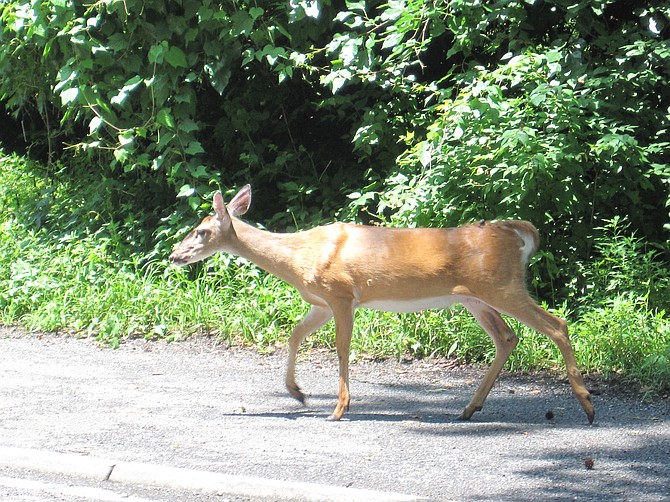
White-tailed deer are quite at home in suburbia and perhaps too much so.
From Sept. 12 to Feb. 13, Fairfax County will conduct annual “deer management” using archery, sharpshooting, “human exclusion, repellency and habitat modification.” The last three, non-lethal methods, are county recommendations to property owners, such as fencing, tree guards, repellents and plants unpalatable to deer.
Deer management is needed, officials say, because of collisions with vehicles, disease transmission and harm to forest regeneration, forest composition, ecosystem services and biodiversity. Too many deer can degrade habitat by eating seedlings, saplings and valuable native plants.
Wildlife biologist Jordan Green elaborates, “In Northern Virginia, the need stems from an ecological imbalance where too many deer on the landscape degrade native habitats to the point of making it difficult to impossible for some other native wildlife species to survive. In addition, a higher concentration of deer has implications for the greater spread of disease, such as chronic wasting disease and the higher risk of deer-vehicle collisions.” Green is with the Virginia Department of Wildlife Resources.
How Many Deer Are Too Many?
“Suburbia’s rise supercharged the whitetail’s recovery,” wrote Ben Goldfarb in his book “Crossings.” “Deer thrive in edge habitats, transitional zones where delectable meadows bump against the shelter of forests.”
Fairfax County officials have conducted deer density surveys in certain parks using cameras and drone surveys. Their goal is to “manage local deer populations to balance the varied needs and reasonable expectations of a diverse human community (cultural carrying capacity), the requirements of a biologically diverse ecosystem and the anticipated future social/ecosystem demands. Hunting is the preferred population management method, where appropriate and feasible.”
Historically, in the eastern U.S., animals like cougars, bobcats and red wolves were their primary predators. Today, few natural predators remain in Northern Virginia.
Deer Hunts
In fiscal year 2026, hunters “harvested” 752 deer in Fairfax County using archery and sharpshooting.
This year, hunters using bows and arrows will operate in over 100 parks from tree stands. The county will post orange “deer management” signs at park entrances and trail heads and send letters to around 27,000 property owners adjacent to the park sites. Archers and hunters must complete hunter safety education courses and have certain qualifications.
The Fairfax County police will conduct sharpshooting at night in secured parks when parks are closed and shoot at static locations over bait from elevated positions. They will donate the venison to local food banks and Hunters for the Hungry. In 2026, they donated an estimated 5,610 pounds of venison.
Vehicle Collisions
“Deer-vehicle collisions are the primary cause of deer deaths in suburban areas without other lethal control,” says the county police department’s website. In 2025, there were approximately 120 deer-vehicle collisions in Fairfax County with the highest numbers of collisions occurring in October and November and the peak time for collisions being 6 a.m.
Virginia ranks ninth in the country for collisions. A Virginia transportation official has estimated that only ten percent of deer-vehicle collisions are captured in police records.
Feeding Deer
Some people intentionally or unintentionally feed deer, says Dr. Gino J. D'Angelo, Associate Professor of Deer Ecology and Management at the University of Georgia.
Some well-meaning people put out corn. WalMart sells millions of bags of “deer corn,” he says, and some packaged deer corn carries the aflatoxin fungus.
Deer also will knock bird seed out of feeders and eat what falls out. Grain-based food can be high in carbohydrates. “A deer’s gastro-intestinal system cannot manage a high influx of carbs and they can increase acid buildup,” D’Angelo said. Also, congregating deer can transmit disease through their saliva, feces and urine, he said.
White-tailed Deer
As they bound away, white-tailed deer flash their erect tails’ white underside. The males, called bucks, have antlers and are larger than females, called does.
Bark scraped off a tree may have been done by deer because their antlers are initially covered with hair called “velvet” and they rub off the velvet before rutting or mating season. In Virginia, rutting season is usually from late October through November when bucks may have heightened activity as they compete for does’ attention.
Fairfax County’s program is a model, Dr. D’Angelo offered. “Many wildlife professionals view programs in Fairfax County and the D.C. area as leaders in urban deer management programs. We are learning from the way they do this work.”
Information
Fairfax County, www.fairfaxcounty.gov/wildlife/deer-management-program
Locations of archery and sharpshooting, www.fairfaxcounty.gov/wildlife/archery-program and www.fairfaxcounty.gov/wildlife/sharpshooting.
Virginia Wildlife Conflict Helpline, 855-571-9003