Have you heard that the closed portion of Pohick Stream Valley Trail has reopened? That’s right. After more than a year, the trail is open again. And while those users who have discovered the reopening are quick to tell you it has been a long wait, they also are quick to add how delighted they are with the trail resurfacing and beautiful landscaping.
The trail runs along Pohick creek in a well shaded, heavily forested area and is a favorite trail of walkers, runners, dog walkers, road bikers, and families with strollers. With the recent rains, the creek is running fuller than most August/September months, with delightful rills and small waterfalls; and fall wildflowers are in bloom along the creek and in adjacent small meadows.
Pohick Creek starts in Burke and empties into Pohick Bay, after running through Springfield, Newington and Lorton for about seven miles, providing a bit of escape into nature from suburban activity for many surrounding communities. Part of the southern portion of the Gerry Connolly Cross County Trail was closed in March 2025, for safety and equipment movement during the Pohick Interceptor Rehabilitation Project, under the management of the Department of Public Works and Environmental Services (DPWES). The sewer system renewal project addressed 6,500 feet of 20-to-54-inch diameter sewer pipe which runs along the creek to allow gravity to move the sewage toward the treatment plant. The $7.3 million dollar project was meant to address the aging infrastructure and prevent costly emergency repairs. DPWES indicates that landscaping was roughly 6% of the total project cost.
The use of an upgrade method called Cured-in-Place-Piping (CIPP), allowed for inserting and setting a resin liner inside the existing pipe, without need for digging up the old or creating open earth trenches. Large diameter pipe was surface-laid to create a temporary bypass pumping line during the upgrade work. The liner resin material can then be installed in the existing pipe and set with a UV light train. The process uses intense UV light to trigger a rapid chemical reaction in the resin, causing it to harden almost instantly. Closed circuit TV cameras let the operator check that air pressure has properly aligned the resin liner with the old pipe before beginning the setting process.
According to Pleasant Construction employees on site, the UV light method reduces styrene emissions compared to traditional hot water or steam curing; nearly eliminating an odor similar to model airplane glue. Engineering and construction were handled by area companies Dewberry and Pleasants Construction.
The CIPP method also allowed for less impact to existing trees and for avoiding disturbance of wildflowers. Several trees did need to be removed to accommodate the large temporary sewer bypass line as well as a few trees in the sewer easement. DPWES advises, “We do not allow for trees to be planted in our sewer easements as roots can penetrate our pipes causing blockages that can potentially lead to sanitary sewer overflows as well as groundwater infiltration.” DPWES then followed FCPA planting requirements: for every 6-inch diameter or greater tree removed outside of the easement, a 2:1 inch-diameter replacement was made.
Most trail users are oblivious to the modern processes that went on under the ground. They are instead taking note and delighting in the beauty and availability of the trail. The resurfacing has eliminated mudding spots where water often stood near the Wadebrook Terrace trailhead entrance. New native trees and shrubs, planted at forestry level quantities, beautify the trail verges. Vilma Castro, of Lorton, says, “It’s beautiful. I walk here every day. It was horrible to wait; I was waiting and waiting. Now it’s good to see it so beautiful.”
Deniz Polat, of Lorton, agreed, “It’s nice. It took a long time to get done, but, especially near the beginning, it won’t flood now.”
New users of the trail, Tam Tran, and Kenan Mozaffar, of Springfield and Fort Belvoir, only discovered the trail recently and did not know that it had been closed. They praised how well it fit for their use as they are “training up our cardiovascular health with run/walk exercise.” Tran, who studied environmental science, called it “gorgeous,” said she “is loving finding a close nature trail, that is so nice.” Mozaffar commented on the “beautiful scenery, with the stream nearby; really a sublime thing to look at.”
Another exercise user, Laura Haberkorn, of Lorton, is walking the trail as part of her walking challenge to reach her 26-mile goal by the end of the year, adding a mile per week. “I love the trail. As soon as you walk here you leave the hustle and bustle of I-95. It all goes away as the quiet of the trail puts you in a Zen place; and you get to meet your neighbors here.”
Bryan Rourke, of Springfield, dropped onto the main trail from a connecting social trail, coffee mug in hand. He said, “I like it for the soothing water, and big natural rocks, and it’s very shady and secluded. A bit of nature though surrounded by suburban development.”
Many only appreciate the nature vibe. Others who know something about trees, praise the variety of new plantings. Springfield native plant nursery Earth Sangha co-founder Lisa Bright, was on site with staff member, Shogofa Aruba, checking the occurrence of invasive plants in the stream valley, and noted the increased variety. The tree species list selected for new plantings was suggested by Dewberry staff and reviewed by FCPA Natural Resources Branch staff. Some needed to be replaced based on summer plant availability. Several were types that were not previously found in this section of woodland. Added were buttonbush, hornbeam, hophornbeam or Ironwood, sweet leaf, and witch-hazel, among others.
Rachel Jackson-Roth, an ecologist with the group shares, “We always want to highlight native plants being used for restoration, and diversity of species, to ensure the forest can survive when new pests, diseases and the pressures of invasive non-native species occur.” The County has included extended watering care in the project contract for a year; after which care of the trees falls under FCPA.
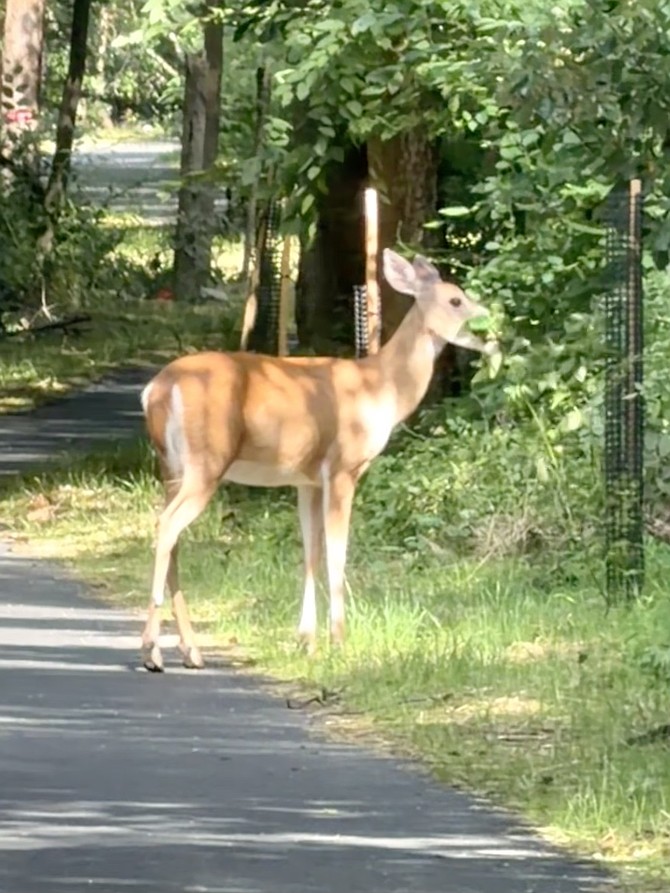
Many of the newly planted specimens have been caged for protection from wildlife predation while they get established and continue their growth. Apparently for good reason, as White Tail deer already were observed showing the new plantings a welcome in their own way.