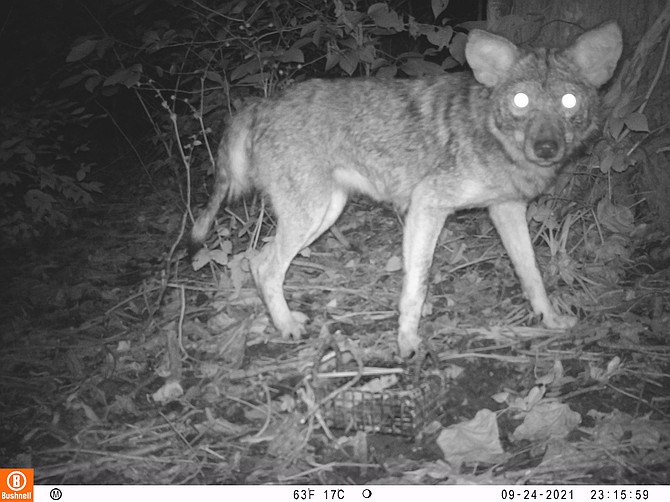
>Looney Tunes’ Wile E. Coyote, a devious, wacky and always hungry cartoon character, may be many people’s image of a coyote, but these animals are “smart and secretive,” says Katherine Edwards, Fairfax County’s Wildlife Management Specialist.
Coyotes are “super-fascinating,” University of Maryland master’s degree candidate Lavender Harris told attendees at an Aug. 28 natural resources symposium, in describing her wildlife camera survey of coyotes in the Washington region. The study area stretches from College Park, Maryland, to Fairfax County’s Mason and Mount Vernon magisterial districts.
In the project’s six years, the cameras have captured over 100 coyotes in Huntley Meadows Park, for example. She has documented over 100 in Rock Creek Park in Washington, D.C., also. Unrelated to her work, a Friends of Dyke Marsh camera photographed a coyote in the preserve in 2021.
State and Fairfax County officials do not have population estimates for coyotes, but they are well-established and sightings have been increasing in recent years in Fairfax County, says Edwards.
Coyotes are “very new to the D.C. area,” Harris said, with the first one spotted in 2003 in Rock Creek Park. They’ve been observed in Virginia since the 1980s. They have spread to the eastern U.S. because of the elimination of other large carnivores, like wolves and mountain lions, experts say.
Detections are higher in the spring and winter, Harris said. Coyotes breed from November to February and have pups in late April and May. While they usually are most active at night, in the spring they may be seen more often during the day when adults are searching for food for their young.
A Few Facts
Coyotes can be grayish tan to reddish and have pointed and erect ears, a slender snout and bushy tail pointed down when running.
“The eastern coyote is a variant of the western coyote and is larger, averaging 48-60 inches in length and 30-40 pounds in weight,” reports the Chesapeake Bay Foundation.
Coyotes produce one litter a year of five to seven pups. Their den sites include banks, thickets and brush covered slopes. They will also den under decks and porches.
“Coyotes play an important role as natural predators in the environment that help to control rodents and other wildlife,” says Edwards.
“Coyotes are omnivorous, opportunistic foragers with diverse diets that commonly prey on small animals such as rabbits, rodents (mice, rats and voles), squirrels and groundhogs, but will also readily eat amphibians, reptiles, insects, fruits, and plants,” says Fairfax County’s website. They may also eat turkeys and white-tailed deer (primarily fawns) and scavenge on carrion and urban food sources such as garbage, pet food, compost and gardens.
They pose very little harm to humans unless threatened, but coyotes may see small pets like cats and dogs as prey, competition or threats.
Harris said, “People think it’s a large hairy predator, but people should not worry. They do their best to avoid people. They are here to stay so it’s worth learning how to coexist with them.”
Why Care?
Why does Harris study coyotes? “I really want to continue in a career of urban wildlife and human wildlife conflict and coexistence and coyotes are a good focal species for teaching people how to live with them.
“It’s exciting to have a carnivore do so well in an urban area and assimilate in tight spaces,” she said. “People love them and hate them.”
On how to live with coyotes, visit https://www.fairfaxcounty.gov/wildlife/coyote