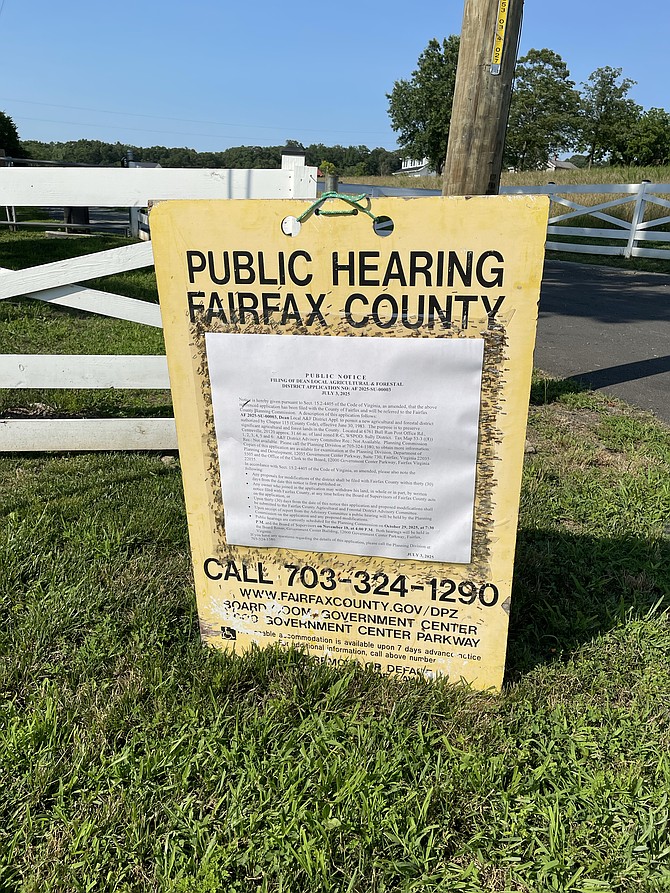
A Fairfax County public notice sign stands on Bull Run Post Office Road during the summer of 2025.
For decades, small yellow 18-by-24-inch public notice signs have been the primary signal of change in Fairfax County neighborhoods — standing as a paper bridge between a developer's proposal and a resident's right to know. But as traffic speeds have increased and neighboring jurisdictions have modernized, community leaders warn that Fairfax County’s signs have become "relics of the 20th century" that are physically difficult to read and impossible to understand, limiting knowledge.
Jim Hart, former member of the Fairfax County Board of Zoning Appeals, and Lewis G. Grimm, of the Sully District Council, say the county has failed to keep pace with modern safety standards. The "notice" provided by these signs is often only seconds long. “If notice is part of due process, does this count as notice?” asked Hart. “A lot of staff effort goes into these signs, I guess, but are any neighbors educated about what is happening, absent additional extracurricular effort?”
At 45 miles per hour, a vehicle covers 66 feet per second. Standard text on these signs is readable from only about 30 feet away. This leaves a driver with just 0.45 seconds to process the message, well below the three-second minimum recommended by safety experts for roadside legibility, according to the United States Sign Council.
A case study in confusion, as cited by Hart and Grimm, is the Hickox Winery Application (AF 2025-SU-00003). Hart noted that the information on these signs is physically impossible to read. "Nobody in their car, even if they came to a full stop, could get any meaningful information from a sign like this, other than something apparently is happening at the government center, sometime. There is no safe place for pedestrians there either," he wrote in an email. He noted that at 45 mph, a motorist would need superhuman vision even to spot the notice, let alone read the fine print. ”Are binoculars required? Zipping by at 45 or faster, it is difficult for motorists even to spot the sign.”
While Fairfax County maintains its 18-by-24-inch standard, nearby counties use larger, more readable formats. Fairfax uses plastic or paper signs totaling 3 square feet with no specified height. In contrast, Prince William County mandates 28-by-44-inch boards — 8.5 square feet — positioned between 3-and-6 feet high. Loudoun County permits notifications up to 32 square feet, with a minimum height of 2.5 feet, to ensure legibility.
The City of Atlanta’s Department of City Planning is recognized for its public notice signs. Bold letters — Z for rezoning, V for variance, U for Urban design and T for tree removal — tell drivers what is happening from 100 feet away. Outlets such as Dezeen, Fast Company, and Bloomberg CityLab have featured the Atlanta signs as a blueprint for 21st-century communication.
In response to concerns, a Fairfax County spokesperson stated its signs are not intended to be a complete information source. "Posted signs are not required as part of the notice and advertising requirements for land use cases in Virginia. … Fairfax County’s Zoning Ordinance does require signs, as a way to alert the community that a land-use action is under review and to point people to where they can find full details. These yellow signs are not designed to be read in full, from a moving vehicle. Instead, they are one part of a broader notification process that also includes mailed notices, newspaper ads, and online postings,” the spokesperson added.
The county views these signs as "alerts" directing residents to digital platforms, such as the Planning and Land Use System (PLUS). “Residents can access complete information through several channels beyond on-site signage. ... When someone searches for ‘yellow sign’ on the county website, they’re taken directly to a page ... where they can open the Planning and Development Explorer and find the case number, the staff coordinator and a link to PLUS for submission materials and hearing dates,” provided the spokesperson as background information.
Grimm notes this digital-first approach leaves many behind. “The lack of knowledge currently being provided ... limits the role of these impacted communities in determining which proposals should be supported and which should be opposed.” He added that the challenges of obtaining timely, detailed information have long concerned Sully District residents.
While Fairfax County staff posts this information, the format remains an ongoing issue. “The members of the Sully District Council of Citizens Associations (SDC) and the Joint Sully District Land Use and Transportation Committee (JSDLU&TC) have brought these concerns to both county staff and our local elected representatives for several years and are still awaiting any improvements,” Grimm said. “There is an old adage to the effect that 'knowledge is power.' The lack of knowledge currently being provided to adjacent properties by the county's development information system limits the role of these impacted communities in determining which proposals should be supported and which should be opposed,” Grimm wrote.
The Sully District Council maintains an independent "Land Use Matrix" to track cases where signs may be hard to read. Residents can also search the PLUS portal for full application details by entering the case number.