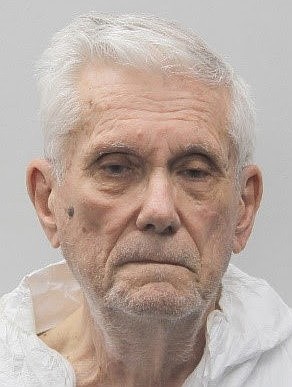
Douglas Sommer
By all accounts, when Marilyn Sommer became ill, her husband Douglas became her uncomplaining caregiver – right up until he murdered her in her sleep. And for doing so, the Chantilly man was sentenced Jan. 9 to five years in prison.
Before imposing sentence, Fairfax County Circuit Court Judge Christie Leary said homicides are always tragic, but especially so when they involve families. She also noted how sad it is when the perpetrator was otherwise a good person.
In this case, Douglas Sommer, now 89, was a career Naval officer for 24 years and a devoted family man who volunteered in his community. Said Leary: “His life stands in stark contrast to his actions that brought us here today – and which have shattered his family.”
The crime occurred Feb. 28, 2025, inside the couple’s home in the 13000 block of Pennypacker Lane in the Greenbriar community. Police responded at 6:09 a.m., arresting Sommer and charging him with second-degree murder and use of a firearm in the commission of a felony.
His wife, 87, died at the scene; since then, he’s been held in jail without bond. On Oct. 20, 2025, Sommer pleaded guilty to reduced charges of voluntary manslaughter and unlawful discharge of a firearm in an occupied dwelling, in accordance with a plea agreement between Assistant Commonwealth’s Attorney Kate Steier and public defender Amy Jordan. It also recommended a sentence of five to 15 years in prison.
Steier told the court that, “In the early morning of Feb. 28, the defendant got his loaded, .32-caliber pistol, went to the reclining chair in the den where his wife was sleeping, and shot her at close range five times in the head and chest,” said Steier. “He then called the police and told them someone had been injured.”
The prosecutor said the couple’s daughter, Jennifer Chivers, who’d been briefly staying with them, came out of her room after hearing two of the gunshots. “She also called the police and, when they came, [Sommer] calmly told them he’d shot [his wife],” said Steier. “The daughter had been staying there to help her parents move into an assisted-living facility. The defendant didn’t want to go.” An autopsy showed the cause of death was the gunshot wounds.
In court Jan. 9, before sentence was pronounced, Steier called Chivers to the stand to testify how her mother’s death had impacted her. “I miss her every day – her laughter and wit,” said Chivers. “She looked forward to moving into the facility and having community. I’ve not only lost my mother, but my dad, as well. The hardest thing is that I’ve lost them both through this. I’m a wreck; I’m seeing a psychiatrist and am on medication. I’m also having stress and health problems with my lungs and liver.
“I couldn’t concentrate at work and still don’t sleep well. When I hear noises in the night, I relive it all over again.” Then, addressing Sommers, she said, “Daddy, I’m sorry. I had to take down all your pictures; I can’t look at them. It’s impacted every step of my life and, also, their grandchildren’s. Christmas was difficult; mom and dad aren’t there anymore. I still haven’t really been able to talk to my dad [about the killing]. “I’m so mad at him, and I don’t understand why he did it.”
Jordan then called five witnesses on Sommers’s behalf. Neighbor Brian Dodd knew Marilyn and Doug for decades, saying they were “quiet, good neighbors and good people.” He said Doug was a good friend, even visiting Dodd’s mother in the hospital when she was dying, and that he was in the Greenbriar Civic Assn. and volunteered at Inova Fair Oaks Hospital.
“He never raised his voice and was always straight to the point,” said Dodd. “We’d chat outside. Marilyn had health problems and it affected him, [but] I could have never imagined him hurting a fly. I never knew he and his wife to have marital problems; it was always a happy, quiet household.”
The Sommers’ next-door neighbor, Jerry Weirich, knew the couple since 1985, but interacted with them more after he retired in 2015. “They were good neighbors, and I enjoyed my conversations with Doug in our yards,” said Weirich. “I didn’t see any problems between Doug and Marilyn. Doug said the medicines she was on didn’t seem to be working. It was rough [on him], and he was concerned that he couldn’t take care of her when he was alone at home.”
Neighbor Michele Dettor said she and her husband knew the Sommers for more than 30 years. “He was very nice, helpful and was our GCA neighborhood block captain,” she said. “I’d see them walking their dogs. But in the last year, I saw Doug more because Marilyn wasn’t well. I’d sometimes see her in a wheelchair or walking with a cane. He volunteered at the hospital three or four days a week.” Dettor said she never saw Doug angry or raise his voice and that he seemed “very caring” of Marilyn.
Dettor’s husband, Joe, said he also knew Doug via the monthly GCA meetings, where Doug was treasurer and he was vice president. “I’m a Realtor, and Doug had asked me to help them sell their house,” said Dettor. “We eventually got the paperwork signed. He told me, ‘This has been the worst six months of my life.’”
Dettor said Doug didn’t elaborate further and never mentioned backing out of the sale. And he, too, said he never saw Doug yell. “He was a matter-of-fact, intentional kind of person,” said Dettor.
Testifying last was Ginny Hackney, Doug Sommer’s younger sister by six years. Living in Boulder, Colo., she said they kept in touch by phone and, once a year or so, she and her husband would visit him and his wife in their RV. The last time was in April 2024. She said her brother was in the Navy and served in Vietnam.
“When I was in college, he took over command of a ship, and I was there for the ceremony,” said Hackney. “He and Marilyn lived in Charleston, Key West, Newport and other places because of his career. He’d be away for nine months at a time.” She said they had a loving relationship and, “Those last two years, when Marilyn’s health was so poor, he took care of her. By April 2024, she lived and slept in that recliner. They weren’t able to do anything.”
Hackney said Marilyn had a hip replacement and pneumonia and, when she was placed on a ventilator, doctors had difficulty getting her off of it. “Their daughter would spend a few weeks with them, every month, to help take care of her and give Doug a break,” said Hackney. “Doug was depressed, but he never complained. He felt awful about what was going on. She had so many health issues, including lung problems, over the years.”
Prosecutor Steier said cases like this are difficult “when the victim is the person you used to love. The defendant would have you believe this crime was committed out of compassion, [when] it was sheer selfishness. In his presentencing report, [Sommer] said he saw his grandmother sick and bedridden for three years, and he never wanted to find himself in that position. And in a jail call to a neighbor, he said, ‘I just lost it, I fell apart. I couldn’t stay in that house. I thought I was caught, and I fell apart.’”
Furthermore, said Steier, Sommer wrote a letter stating, “I could not take care of her. I was broken; I snapped. I couldn’t face Marilyn’s sadness anymore.”
“That’s why this happened,” said Steier. “He didn’t do this for mercy or to ease her pain, but to help himself. The solution was assisted living. He ripped the last years of her life away from her and her daughter and grandchildren. She deserved to die with dignity, not by five gunshots from the man she thought would always protect and love her.”
Afterward, Steier said, “He told his daughter what he did and then lied to the 911 caller that there was an intruder. This was callous and calculated. He [also] described killing her as ‘water under the bridge.’” In their victim-impact statements, said Steier, Marilyn’s daughter and granddaughter described her as a strong, compassionate woman excited about going to the assisted-living facility and being involved in the community there.
“This wasn’t a woman who was ready to die,” continued Steier. “The defendant’s age doesn’t negate the harm of this crime or adequately provide justice for Marilyn’s death. In Jennifer’s letter, she wrote, ‘My mother’s life mattered, [as did] what was done to us.’ The commonwealth [requests] a 15-year sentence.”
Arguing for five years, instead, Jordan said, “It’s not reasonable to believe [Sommer] changed his personality overnight. Marilyn was hospitalized several times, for long periods that past year and it took a toll on him. They planned to sell the house, but he didn’t want to give up his independence. They were married more than 64 years, raised three children and, sadly, had to say goodbye to two of them. They shared a lot together during their marriage.
“Marilyn was his life and, when she became ill, he took care of her. Being in his upper 80s, it was difficult for him, but he did it. Also serving his country and community, he lived a selfless life. They spoke that night, and Marilyn questioned why she was still there. She couldn’t do anything for herself. Doug worried about her. Compassionate killings do happen.”
“He wasn’t motivated by maliciousness, selfishness or hatred,” said Jordan. “The sentence should reflect that and what he was going through. This has caused him a great deal of pain because of ending the love of his life and because of how it affected their daughter and granddaughter.”
Sommer then stood and apologized. “I loved Marilyn very much; she was my rock,” he said. “This was my fault. I caused grief to my daughter and grandchildren. I wish I could take this all back, but I can’t. I’m sorry for the loss of Jennifer’s mother, coupled with the sense of grief and betrayal [she feels]. I let my family down.
“Marilyn loved them, and I understand I robbed my daughter, grandchildren and family members of their chance to say their final goodbyes to her. This is not fair, and I’m sorry for the pain my actions caused.”
Before sentencing Sommer, Judge Leary said, “His actions are in contrast to the life he lived for so many years. Through today’s testimony, the court received a snapshot of a man who served his country for [nearly] 30 years and heard about his devotion, commitment and love for his family and his wife of almost 65 years.
“This case’s circumstances are tragic and hit home for many people being caregivers, aging and having health problems, and moving into assisted living. No amount of time imposed will ever bring back the loved one. Mr. Sommer will not forget his actions, and he’s accepted responsibility for them. It’s apparent that it’s heartbreaking for everyone involved. Any sentence will likely result in him dying in prison, so the court will accept the plea agreement.”
Leary then sentenced him to 10 years in prison, suspending five, for the voluntary-manslaughter charge, and five years, all suspended, on the firearm charge. She also placed Sommer on five years’ probation upon his release.
Afterward, outside the courtroom, Hackney said her brother told her “he’s sorry and that [what he did] was stupid.” Regarding the sentence, she said, “I think it’s fair. He expected some time in prison. I don’t think he’ll ever get out – Doug’s done. He basically thinks his life is over and he’s just biding his time.”
Before the shooting, said Hackney, “He was depressed. He loved Marilyn ’til he killed her. He’d devoted his life to her. Never in a thousand years would I have believed he could have done this. I’ll visit him in prison, wherever he is. I won’t forgive him for what he did, but he’s a good person. What he did is not who he is.”