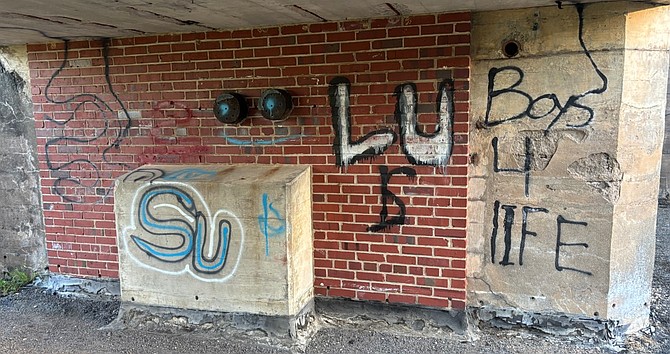
A section of Battery Mount Vernon before being cleaned by National Park Service employees.
The U.S. National Park Service (NPS) requests the public’s help in reporting graffiti on historic structures at Fort Hunt Park. Park officials say that “for years” the 19th-century concrete batteries have been the target of vandalism. Park staffers have found letters, drawings and paint smears on them.
The park, located five miles south of Alexandria City on the south George Washington Memorial Parkway in the Mount Vernon area, attracts people for picnicking, recreation and community events. It is a unit of the 25-mile parkway, managed by the U.S. National Park Service.
In April, NPS rangers, preservation specialists and maintenance crews from around the country cleaned up and removed graffiti using low-pressure washing, hand scrubbing, non-acidic cleaning agents and repeated rinsing to remove paint from the porous surfaces without stripping original material.
“Thanks to the hard work of National Park Service professionals, Fort Hunt Park is once again looking its best. The cleanup effort helps ensure the park remains a clean and welcoming place for the thousands of people who visit and use the park each year,” says the NPS website.
Report Suspicious Incidents
To report suspicious or criminal activity, contact the U.S. Park Police at 202-379-4877 or email USPP_TIPline@nps.gov and provide as much detail as possible.
Fort Hunt Park’s History
Indigenous people hunted and fished in the Fort Hunt area from 6,000 B.C. to the mid-1700s. English explorer Captain John Smith encountered the Conoy tribe in the area in 1608. Later, the land became part of George Washington’s Mount Vernon plantation where he established a “slave village.”
In 1885, when federal officials decided that the United States was not prepared for naval attacks, the War Department built multiple artillery batteries between 1898 and 1904 to defend the Potomac River and the nation’s capital, intended for the Spanish American War. The batteries have a semicircular top so guns could swing around. Shells could weigh several hundred pounds and were raised from below on elevators. The installation was named for Brevet Major General Henry Jackson Hunt (1819-1889).
The battery commander’s tower, with concrete walls over two feet thick, looks today much as it did when completed in 1902. From the top, the commander could see down the Potomac River and coordinate the firing from the batteries.
During the Great Depression, the site was used as a Civilian Conservation Corps (CCC) camp. The CCC planted two clearly aligned rows of trees in the 1930s that today mark the camp’s service road. A pin oak still standing honors the 1939 visit of England’s King George VI and Queen Elizabeth.
In World War II, from 1942 to 1946, Fort Hunt was a top-secret camp for interrogating 4,500 German, Japanese and Italian prisoners of war (POWs), given an intentionally innocuous name, P.O. Box 1142. Many prisoners were Nazi naval officers and German scientists.
Most of the covert camp’s facilities were demolished, replaced today by grassy fields, a few woodsy areas and popular picnic pavilions. Remaining from that era are four chunks of cement which were bases of former guard towers.
“The recent cleanup effort ensures that visitors can continue to enjoy the park in a setting that reflects its historical significance and natural beauty,” the NPS announcement notes.