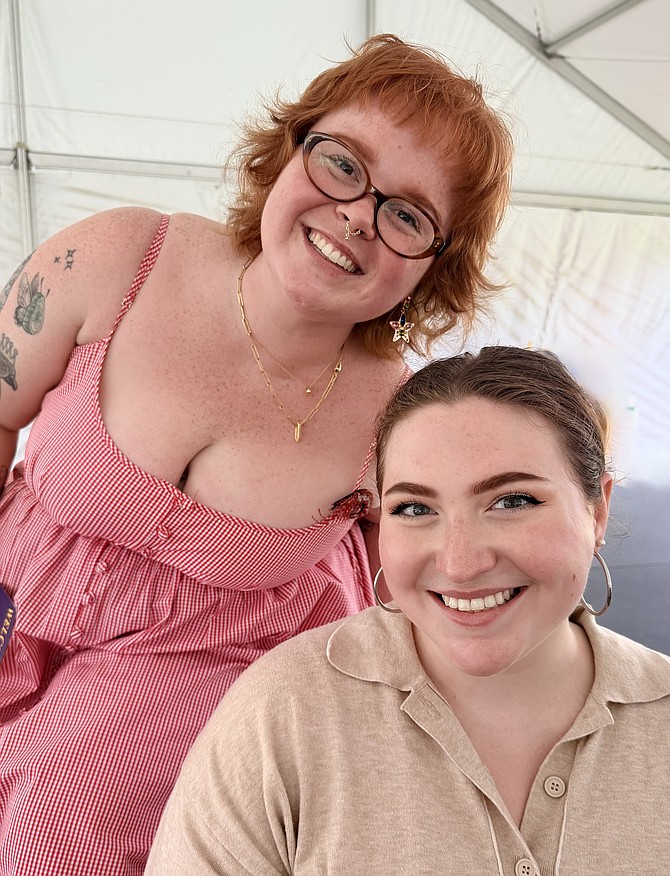
“Suffs” portrayers of Lucy Burns, Gwynne Wood and Gretchen Shope, pose after their Learning at Lunch lecture at the Workhouse Arts Center
Lorton has claim to some of the most infamous events of the suffrage movement which eventually led to passage of the right to vote for women in 1919. Some have opined that the women’s treatment in Lorton hastened the long sought right to vote for women. The Workhouse Arts Center now houses a Lucy Burns Museum, dedicated to providing a glimpse into the suffragist movement in which she played a major part.
On June 18th, the Center hosted two actresses currently portraying Burns and other important historical figures in the movement, in the Broadway play, “Suffs,” Gwynne Wood, as Lucy Burns, and Gretchen Shope, who understudies for the role.
During the question and answer format, the players provided insights about the show to a large audience. Organizers were surprised by the number of participants. Many in the audience had seen the play multiple times. And many present were planning to see the show during its run in Washington DC.
The Arts Center reached out to the National Theatre, noting their shared role in educating about the suffrage movement. The cast members came to the Workhouse to do a Learning at Lunch series presentation. The Arts Center reciprocated by promoting information about “Suffs” tickets at the National Theatre on the Arts Center web site.
“Suffs” played on Broadway as a musical, with a book, music, and lyrics by Shaina Taub. It centers on the American women’s suffrage movement and the activists who fought for the vote. The show follows figures such as Alice Paul, Carrie Chapman Catt, and their allies and rivals, as they navigate protest, organizing, and political pressure in the years leading to ratification of the 19th Amendment. The show began at The Public Theater before transferring to Broadway, where it played the Music Box Theatre. The production earned major recognition including Tony Awards for Best Book of a Musical and Best Original Score.
Selected questions and answers which represent a feel for the hour long interaction are provided here, edited for length.
Q - What resonated with you about the suffragist movement and the women?
A - Wood - We take [the women] for granted. It’s crazy that we don’t know more of their names and talk about them more.
A - Shope - Reading and watching “Suffs” for the first time, I was surprised how much disagreement there was within the movement. They had heated disagreements, but ultimately managed to work together for the same goals.
A-Wood - I resonate with Lucy Burns the most. Knowing her whole history and her interest in drama, which allowed her to be comfortable talking to crowds. In small ways I’m like her. [Lucy Burns, with Alice Paul, founded the National American Women Suffrage Association.].
A - Shope - I resonate most with Inez [Milholland] and her use of theatrics. [Inez Milholland, a lawyer and activist, rode a white horse at the head of the 1913 suffragist parade in Washington DC].
Q- Is there an “it” scene from the cast's perspective?
A - Wood - The scene before Alice Paul sings “Worth It.” It’s a lighter scene but it sees them as “real” women. It makes larger scenes more impressive. It shows they experienced some emotions, dealt with them, and that we are all capable of great things.
A- Shope - “Respectfully Yours, Dudley Malone.” The audience always responds to the male empathy with the suffragist movement. In this world, there’s a tendency not to believe women. So the audience is able to receive the empathy in a different way.
A- Wood - Being here in Lorton and the Washington area, everyone here understands all the political elements behind the story. In Minneapolis, they were on the edge of their seats listening to Mary Church Terrell’s character comment about that the police would not do anything [to protect the demonstrators]. [Mary Church Terrell was an African American activist and suffragist, who helped found the NAACP, and the National Association of Colored Women.] There was an audible reaction from the audience and the show felt heavy in the time when we were in Minneapolis close to when Renee Nicole Goode was murdered.
Q- What about the sub themes, as the show seems to embrace segregation; it addressed that the march was segregated and pushed colored women aside, queer women in the movement, and those with immigrant status; not paying more attention to intersectionality?
A-Wood - There are so many sub-themes, I feel comforted by the cyclical nature of everything. Characters aren’t chastised for wanting things to change and be better. As we look back on their successes and failures, criticism and critique is a vital part of getting better.
Q- Why was the title “Suffs” chosen?
A- Wood - “Suffragist” was considered. The idea was to draw away from the use of the term “Suffragette.” But there were other projects already in production first called “Suffragist.” They wanted a one work title and wanted to emphasize the movement, not just one person.
A-Shope -“Suffs” seems a friendlier term; more relatable; making audiences feel a part of the group.
Q- Why is it an all female cast, even the portrayal of President Wilson?
A- Wood - The cast members are all female or non-binary. It was important to add gender diverse folks to the cast. It brings older history into the present. The goal of the show was to center on these women, but with the violence involved, didn’t want it to be too graphic. All females in the roles allows women to stay central, even the President.
A- Shope - In history we give Woodrow Wilson too much credit. So being played by a woman in drag kind helps put him in his place.