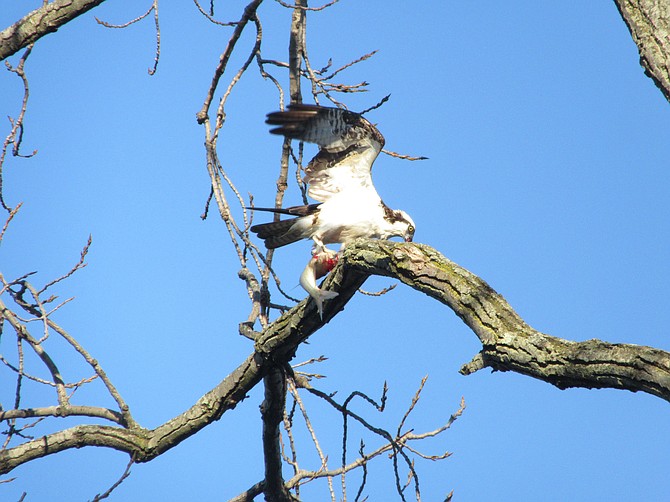
Again this year, people near waterways have been intrigued by our annual avian “visitors,” the ospreys that return in March, mate, raise their young and then migrate to their wintering grounds in August.
Excellent anglers known as “fish hawks,” ospreys are chestnut brown and white birds, around 23 inches long, with a four- to six-foot wingspan and a dark eye stripe on the side of their white head. They build nests near water on trees, platforms, channel markers, waterfowl blinds and other manmade structures.
Convenient Viewing
January’s two-plus-week ice siege froze parts of the Potomac River and pushed down a longstanding platform at the Belle Haven Marina where many have delighted in watching a beloved pair raise their young for many years. Neither the marina nor the National Park Service has committed to replacing the platform.
Undaunted, presumably the same pair, moved slightly north and built a nest on the flat roof of what locals dub a “tiki boat” where they are raising one young. The boat’s owner agreed not to disturb the nest. In the southern part of Dyke Marsh on Angel Island, a pair is raising two young.
Meanwhile, Porto Vecchio’s residents have front row seats to ospreys from their windows and terraces, enjoying the parenting underway in two nests. One nest has three young; the other, one.
Again this year, ospreys refurbished last year’s nests on Walt Whitman Middle School’s ballfield utility pole and atop the pole at Martin Luther King Park. No one has confirmed young in those nests at this time.
On the Mason Neck peninsula and Pohick Bay in May, surveyors counted 38 pairs with 53 chicks total.
Arina van Breda who lives on the Potomac River in the Mount Vernon area watched a pair this spring that she says “seemed like young ospreys and not very good at nest refurbishment, certainly nowhere as accomplished at nest rebuilding as prior pairs. It reminded me of teen parents who have the general idea about how things are supposed to be done, but not good on the details and follow through.” She thinks the birds laid some eggs, but “then they up and vanished sometime while I was out of the country.”
Some Ospreys in Trouble
In the southern, saline part of the Chesapeake Bay ospreys are struggling. A May 2025 survey of nesting ospreys on Virginia’s Delmarva Peninsula, led by Dr. Bryan Watts of the College of William and Mary’s Center for Conservation Biology, reported a 90 percent decline there, what Watts called, “a nearly complete collapse of the population.”
Asked about this season, on June 23, 2026, Watts emailed, “The season is shaping up to be one of the worst that we have ever documented in the saltier parts of the Bay. Some of our study areas have already closed out for the year and others have very few active nests left. Many pairs abandoned territories early this year.”
In a recent Audubon magazine article, David Gessner quotes Watts: “Osprey chicks are starving in their nests. And the reason is simple. Their primary food source is menhaden. And that food source is no longer abundant.” Some blame Ocean Harvesting for commercially over-fishing menhaden, a controversial issue that’s been raging for some time. In the recently-resolved Virginia budget, the legislature approved $2 million for a study to try to clarify the facts.
Osprey Facts
Ospreys mate for life. They typically incubate one to four eggs for 36 to 42 days. Their nests look like unkempt bundles of sticks and can be three to six feet across and 10 to 13 feet deep. The birds may add odd objects like plastic bags, shoes, fast food debris and toys to the nests.
Ospreys can become entangled in things like plastic bags, balloon ribbons and monofilament fishing line. Porto Vecchio residents disentangled an osprey from fishing line a few years back.
To catch a fish, ospreys typically scan the water, hover and suddenly plunge feet first to grasp a fish in their sharp talons. They then fly to a nearby spot to eviscerate the prey or take it to its mate or young in the nest.
Over their 15- to 20-year lifetime, ospreys may migrate more than 160,000 miles.
Watch Them Here
A few years back, William Young produced two videos about the ospreys at the now downed platform at the Belle Haven Marina boat ramp:
http://www.youtube.com/user/williamyoung42?feature=watch
http://www.youtube.com/watch?v=-1PN1YiF3rc