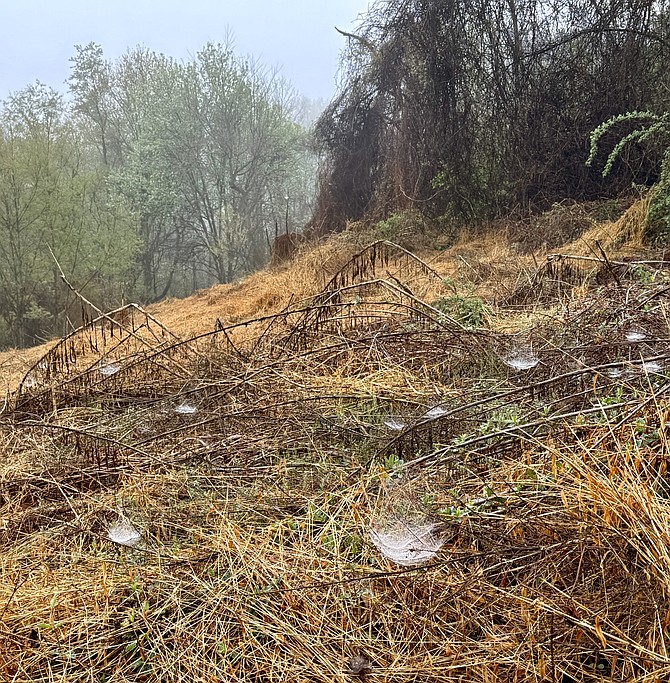
Morning dew reveals a mystery world of Bowl and Doily Spider webs in Laurel Hill Park
A winter snowfall reveals the magical appearance of footprints and the paths of woodland creatures, which without the snow, would have gone undetected. A spring or summer morning dew also opens a hidden world of spiders, in this case the habitation of the Bowl and Doily Spider (Frontinella pyramitela).
A common spider in the United States, one might often pass by their webs in weedy fields or in shrubs and bushes. But their lacy and intricate webs are not easily seen without dew or rain drops to give them away. The tiny spider, just three or four millimeters in size, waits for its prey, gnats, mosquitos or small flies, within the protection of its web. The complex web, with an inverted round shape, the bowl, is suspended above a horizontal sheet web, the doily. The spider waits, clinging to the underside of the bowl, within the protection of the second tier web. When prey enters the web, the spider sprints to the spot, injecting venom to paralyze the prey. The venom is lethal to small insects, but is not dangerous to humans.
Examine these webs closely in the spring, and you will likely find only a single spider within; a female. By late summer, a male may join the female during the prolonged mating period. They create a co-habitation unusual among spiders, which are typically solitary. The males do not build webs themselves; relying on females for housing and fodder.
If you find a web, look closely for the tiny reddish brown spider with yellowish legs. Be sure to conduct your search in the dewy, early morning hours. As the morning sun dries the air, the webs will seem to disappear, like the sails of ghost ships, or the wings of meadow fairies, of lore. The webs will still be there, but hiding in plain sight.